Funding Intervals: 1h, 4h or 8h Explained
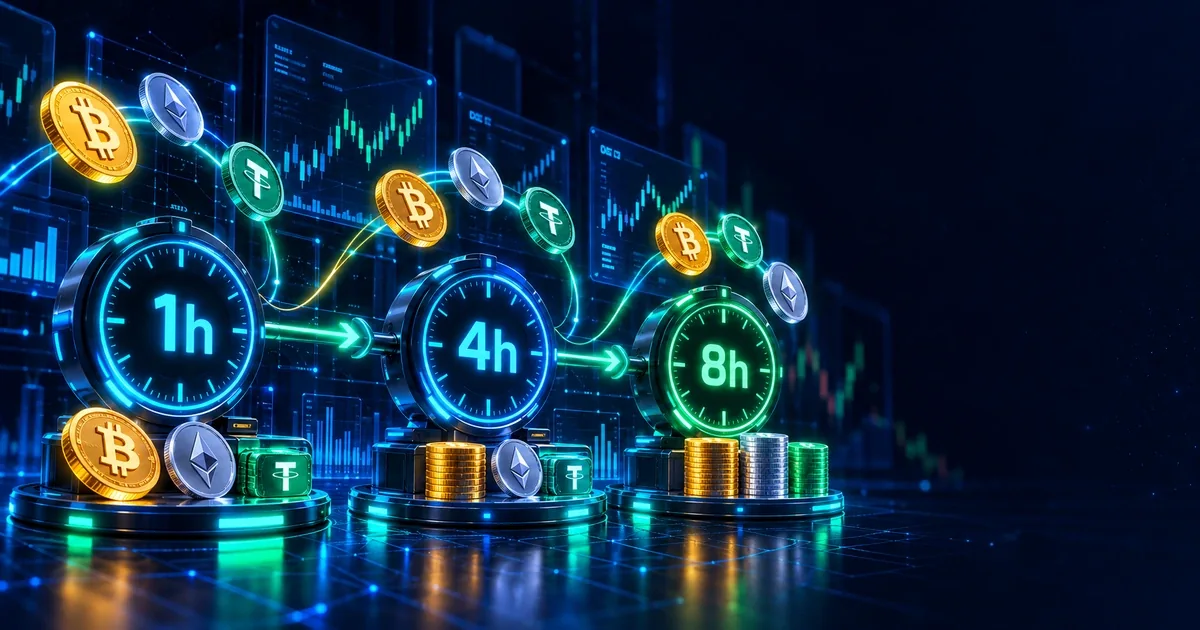
Not all funding is paid at the same pace. Some exchanges pay every 8 hours, others every 4 or even every hour. If you compare only the percentage without looking at the interval, you can pick the wrong opportunity.
Why intervals change
The interval is a decision made by each exchange and, sometimes, by each contract. More volatile coins, or those with more aggressive funding, tend to have shorter intervals so the market can adjust faster. Some exchanges change a coin's interval with little notice during periods of strong volatility.
Always compare on the same basis
A funding rate of 0.04% every 8 hours is not the same as 0.04% every 4 hours. Over 24 hours, the first earns 0.12% (3 payments) and the second 0.24% (6 payments). To compare, convert everything to the same basis, such as "per hour" or "per day".
| Funding per payment | Interval | Payments per day | Total per day |
|---|---|---|---|
| 0.04% | 8h | 3 | 0.12% |
| 0.04% | 4h | 6 | 0.24% |
| 0.04% | 1h | 24 | 0.96% |
The values are only to illustrate the math. In practice, funding changes with every payment.
Different intervals on the two legs
In arbitrage, the two exchanges can pay at different times and paces. One leg may receive every hour and the other every 8 hours. The total gain for the period is the sum of what each one pays or charges during the time you stayed positioned.
This changes the strategy: if you exit before one of the legs pays, you don't receive that payment. That's why Funding Day Trade enters close to the payment time and Funding Scalp works in a short window around it.
How Multi Arbitrage handles this
The system reads each coin's real interval on each exchange, calculates the efficiency per payment and shows a countdown to the next one. It also checks the funding actually paid against the exchange statement, so it doesn't rely only on the predicted rate.
An example comparing different intervals
Exchange A pays +0.03% every 8 h. Exchange B pays +0.01% every 4 h. Staying short on A and long on B for 8 hours: you receive 0.03% and pay 0.01% × 2 = 0.02%. Result: +0.01% in 8 h. If it were the other way around (long on A, short on B), the result would be −0.01%. The interval completely changes the math.
Watch out for interval changes
In moments of high volatility, some exchanges move coins from 8 h to 4 h or 1 h. If the bot assumes an old interval, it calculates the wrong gain. That's why the system re-reads each coin's interval and checks what was actually paid.
Related guide: what the funding rate is. See also all the crypto arbitrage guides.
Frequently asked questions
Where can I see a coin's interval?
On the contract page at the exchange, or on the Multi Arbitrage dashboard cards, which show the time until the next payment.
Can the exchange change the interval?
Yes, in some cases. That's why the system re-reads the interval instead of assuming a fixed value.
Which interval is better?
None is better in itself. What matters is the funding per payment and the frequency together, on the same time basis.
Start with $30 in credits
Connect your exchanges with keys that can't withdraw and let the bot work. You pay 30% of the profit, and only when there is a profit.
Create my account →Read also

Positive vs Negative Funding Rate: What It Means
When the funding rate is positive or negative, who pays and who receives, and how that shows up in arbitrage opportunities between exchanges.
3 min read
How to Calculate Funding Arbitrage Profit
Step-by-step guide to calculating the net result of a funding arbitrage: funding received, fees, spread and opportunity cost, with an example.
3 min read
Funding Day Trade vs Funding Scalp: Which to Choose
Differences between Multi Arbitrage’s Funding Day Trade and Funding Scalp: entry window, duration, minimum profit, risk and who each one is for.
2 min read
This content is for information only and is not investment advice. Trading crypto derivatives involves a high risk, including the total loss of your capital. Past results do not guarantee future results, and the figures mentioned are examples. Before trading, check whether trading crypto derivatives is allowed in your country and what your tax obligations are. Assess whether the product suits your profile before investing.