Crypto Futures Long Liquidations Hit $570M: What to Check
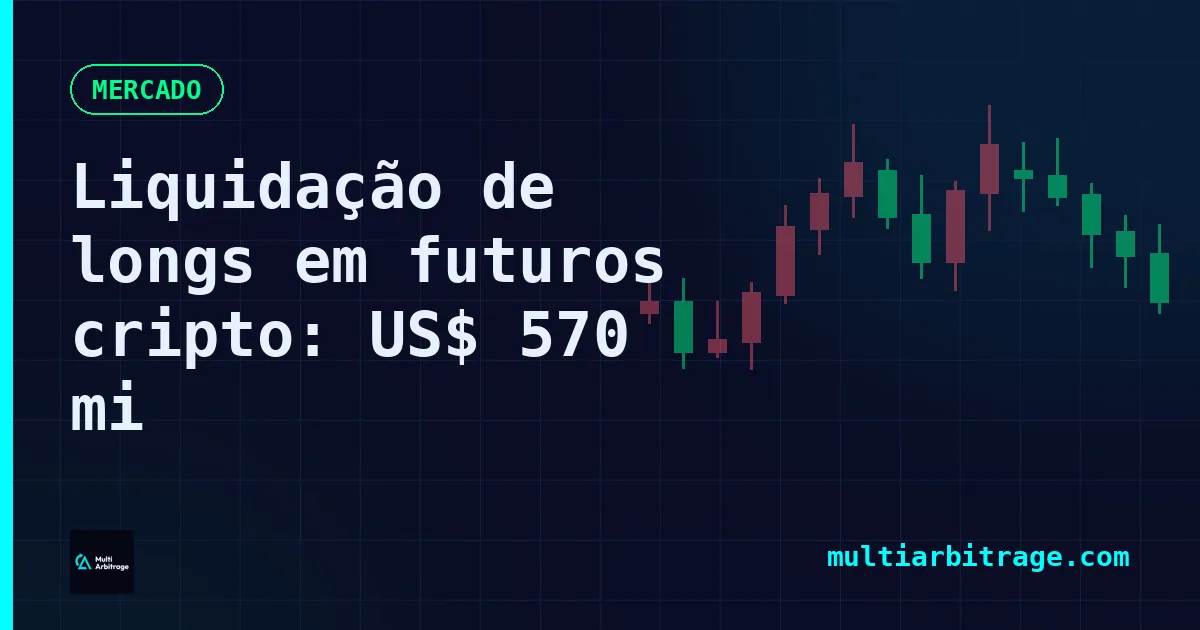
According to CryptoPotato, citing CoinGlass data, liquidated long positions totaled about $570 million in 24 hours, amid a fresh drop in Bitcoin, Ethereum and XRP. Bitcoin briefly fell well below $73,000, a multi-month low, after a US inflation reading came in higher than expected.
For anyone trading perpetual futures or funding arbitrage, the episode is a practical reminder: sharp moves affect the funding rate, the spread between exchanges and the liquidation risk of any position, including those meant to be hedged.
What happened
According to the article, Bitcoin quickly gave back a brief recovery and fell to around $72,700. Ethereum lost more than 5% and sat near $2,010, just above the $2,000 support level. XRP fell by a similar proportion and traded below $1.05, while SOL dropped about 5%.
The CoinGlass data cited by the outlet shows nearly $700 million in positions liquidated over 24 hours, of which $570 million were longs. In the last four hours alone, the total reached $580 million, with $484 million in longs. Ethereum led with $252 million liquidated, and Bitcoin was close to $200 million.
The source also reports that more than 115,000 traders were liquidated and that the largest single position wiped out exceeded $31 million, on HTX.
How leverage amplifies a drop
In a perpetual contract, leverage lets you open a position larger than the capital you deposited. The higher the leverage, the smaller the distance between your entry price and your liquidation price. A moderate drop can be enough for the exchange to force-close the position.
This is where the chain reaction comes in: when a liquidation is executed, the exchange has to sell on the market, which can push the price down a little further and hit the liquidation price of other positions. This is a general explanation of the mechanism, not something the source claims about this specific case.
That is why days with many liquidations tend to come with sharp swings and higher slippage. At those moments the order book gets thinner and execution gets more expensive.
Why this matters for funding arbitrage
In funding arbitrage, the idea is to go long on one exchange and short on another, in the same asset and for the same value, to collect the funding rate difference and reduce dependence on price direction. Even so, each leg has its own margin and its own liquidation price.
In a sharp drop, the long leg loses value and the short leg gains, but the margin on each exchange is separate. If the losing leg runs short of margin, it can be liquidated before the other leg's profit is transferred. That is why risk management in futures looks at each exchange individually.
Another point: in drops, funding tends to get lower or even negative, which changes who pays and who receives. It is worth understanding what positive and negative funding mean before holding any long position. Funding can also flip sign between one payment and the next, which affects the result for anyone who expected to receive it.
Illustrative example: the cost of a funding flip
The numbers below are fictional and only show the math. Imagine a $1,000 position with funding of 0.01% per payment and 3 payments per day.
- If funding favors your position: $1,000 × 0.01% × 3 = $0.30 received in the day.
- If the sign flips and your position starts paying: the same $0.30 becomes a cost.
The amount is small, but it shows that funding is a variable that adds to or subtracts from your result over the day. You can test other values in the funding calculator and check the distance to liquidation in the liquidation price calculator.
Risks and precautions
Drops with mass liquidations increase some risks that already exist in the trade:
- Partial execution: with a thinner order book, one leg can be filled while the other is not, leaving the position exposed to price direction. Understanding IOC orders helps show how this happens.
- Liquidation on one leg: low margin on one exchange can lead to a forced close, even when the two legs together are balanced.
- Spread between exchanges: in moments of stress, the spread between prices can widen and make exiting harder.
- Exchange failure: system or API instability on high-volume days is a real risk in any trade.
High leverage reduces your margin for error. Trading derivatives involves risk of loss, and this content is educational, not investment advice.
What to watch in the coming days
Without trying to predict price, there are indicators readers can follow before holding long positions:
- Funding rate: if funding has turned negative or is flipping sign, a long position carries a different cost. See how this works in high funding rate: opportunity or trap.
- Liquidation map: tools such as CoinGlass, cited by the source, show liquidation data; it is worth watching where positions are concentrated near the current price.
- Distance to liquidation: check how far the price can move before each leg is liquidated, with help from isolated or cross margin.
- Liquidity and spread: watch whether the order book is thinner than usual.
If you want to better understand how to avoid being liquidated, see the guide on avoiding liquidation.
Sources
Related guide: how to avoid liquidation. See also all the crypto arbitrage guides.
Frequently asked questions
What does it mean when longs are liquidated?
It means traders with long positions, using leverage, had insufficient margin when the price fell and the exchange force-closed the position. In the article, this added up to about $570 million in 24 hours.
Does mass liquidation make a price drop worse?
Generally yes, because liquidation involves selling on the market and can push the price down, hitting other positions. This is an explanation of the mechanism, not a guarantee about any given event.
Does the funding rate turn negative after a drop?
It can, usually when there is more demand for short positions than long ones. When it is negative, shorts typically pay longs, but this depends on the exchange and can change with each payment.
Can funding arbitrage traders also be liquidated?
Yes. Since each exchange has its own margin, one of the legs can be liquidated in a sharp drop, even when the two positions are balanced in total. That is why monitoring margin and liquidity is important.
Start with $30 in credits
Connect your exchanges with keys that can't withdraw and let the bot work. You pay 30% of the profit, and only when there is a profit.
Create my account →Read also
Bitcoin Below $60K: What to Watch in Funding Rates
BTC gave back its rally and fell below $60K again. Learn how to read funding rates, basis and liquidations in perpetual futures without predicting price.
5 min read
Nvidia, Bitcoin and Funding: What the Stock Rally Changes
Jensen Huang's return to Nvidia lifted tech stocks and crypto alike. Here is how that moves funding rates and basis for anyone running funding arbitrage.
4 min read
Zcash Liquidation Cluster Swept: What Futures Traders Can Learn
Zcash swept a liquidation zone while the 4-hour chart stays bearish. See what it means for funding, margin and risk in altcoin perpetual futures.
5 min read
This content is for information only and is not investment advice. Trading crypto derivatives involves a high risk, including the total loss of your capital. Past results do not guarantee future results, and the figures mentioned are examples. Before trading, check whether trading crypto derivatives is allowed in your country and what your tax obligations are. Assess whether the product suits your profile before investing.